manufacturer of I/O-rich SBCs, operator interfaces, handheld instruments, and development tools for embedded control low cost single board computers, embedded controllers, and operator interfaces for scientific instruments & industrial control development tools for embedded control order our low cost I/O-rich embedded control products embedded controller manufacturer profile single board computers & embedded controllers development tools & starter kits for your embedded design operator interfaces with touchscreens and graphical user interface plug-in expansion modules for digital & analog I/O C language & Forth language integrated development tools, IDE single board and embedded computer accessories embedded controller enclosures, bezels, environmental gaskets

Search Mosaic
Search the Web
Embedded Computers for Instruments and Automation Catalog

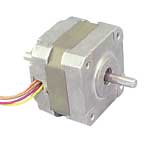
The Mosaic Stepper Motor

stepper motor

The Mosaic stepper motor (part no. STEPMOT-1) is a four phase, unipolar, permanent magnet stepper motor. It is a standard size, 200-steps-per-revolution, NEMA 17 (1.7 in. square footprint, 5 mm shaft diameter), 12 V motor. This motor, like most stepper motors is a permanent magnet motor. The Mosaic stepper is typical of common high resolution motors - a full revolution requires 200 steps, while each step turns the shaft only 1.8º for a full step, or 0.9º in half-stepping mode. This sized motor is commonly used in household appliances, medical equipment, stage lighting devices, and in various industrial control applications.

The following are the physical and electrical specifications of the motor:

Mosaic Part No.:
Manufacturer Part No.:
STEPMOT-1
42BYG228
Size:NEMA17
Drive System:Unipolar
Step angle:1.8º full step / 0.9º half step
Voltage & current:12V at 400mA
Max continuous power:5W
Resistance per phase:30 ohms
Inductance per phase:23mH
Holding torque:2000g-cm
Detent torque:220 g-cm
Rotor inertia:22 g-cm2
Bearings:Ball
Leads:18 in. 6 AWG UL 1007
Insulation resistance:100MΩ min. at 500VDC
Dielectric strength:500V 50Hz/minute
Mounting hole space diagonal:1.73 in.
Shaft diameter:0.197 in. (5 mm)
Motor footprint:1.7 in.square
Motor height:1.5 in.
Ambient temperature:-10ºC to 55ºC
Weight:0.24 kg (0.5lbs)

The motor has six wires, connected to two split windings as is common for unipolar stepper motors. Figure 1 shows the connection diagram for the six leads.
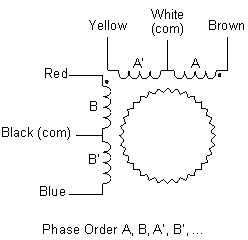
Fig.1Stepper Motor Wiring Diagram. Black and white leads are connected to the common positive supply and for clockwise rotation phases are actuated in the order: A, B, A’, B’, A, B, A’, B’,...

In use, the center taps of the windings are typically wired to the positive supply, and the two ends of each winding are alternately grounded through a drive circuit to reverse the direction of the field provided by that winding. The Motor Wiring Diagram also illustrates the order of the stator poles in the motor: A, B, A’, B’. This is the order in which they must be energized to cause the motor to step in a clockwise direction.

The motor physical dimensions are shown in Figure 2.
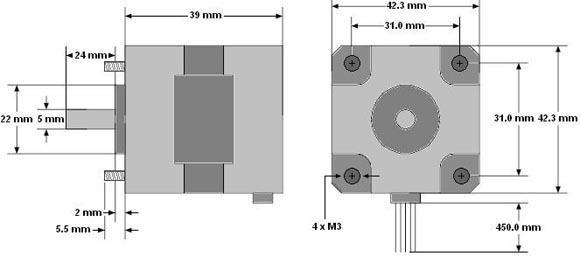
Fig.2Stepper motor physical dimensions. The motor is 1.7" square, 1.5" long, with a 5 mm shaft. Mounting holes take 3 mm dia., 0.5 mm pitch metric screws. Four screws are installed in the back side of the motor. Two diagonally mounted screws are 40 mm long and extend 5.5 mm through the front side and two are 30 mm long and leave a 4.5 mm deep threaded socket in the front.

Do you need stepper motor control? For details go to Stepper Motor Control Using the Power I/O Wildcard,

or download: Application Note MI-AN-072, pdf file (249KB): Controlling Stepper Motors with the Power I/O Wildcard.

Ordering Information

Products Part No
Stepper Motor

A four phase, unipolar, permanent magnet, standard size, 200-steps-per-revolution, NEMA 17 (1.7 in. square footprint, 5 mm shaft diameter), 12 V stepper motor.

STEPMOT-1


Home|Site Map|Products|Manuals|Resources|Order|About Us
Copyright (c) 2003 Mosaic Industries, Inc.
Your source for single board computers, embedded controllers, and operator interfaces for instruments and automation